
The headline number measures only the entrance
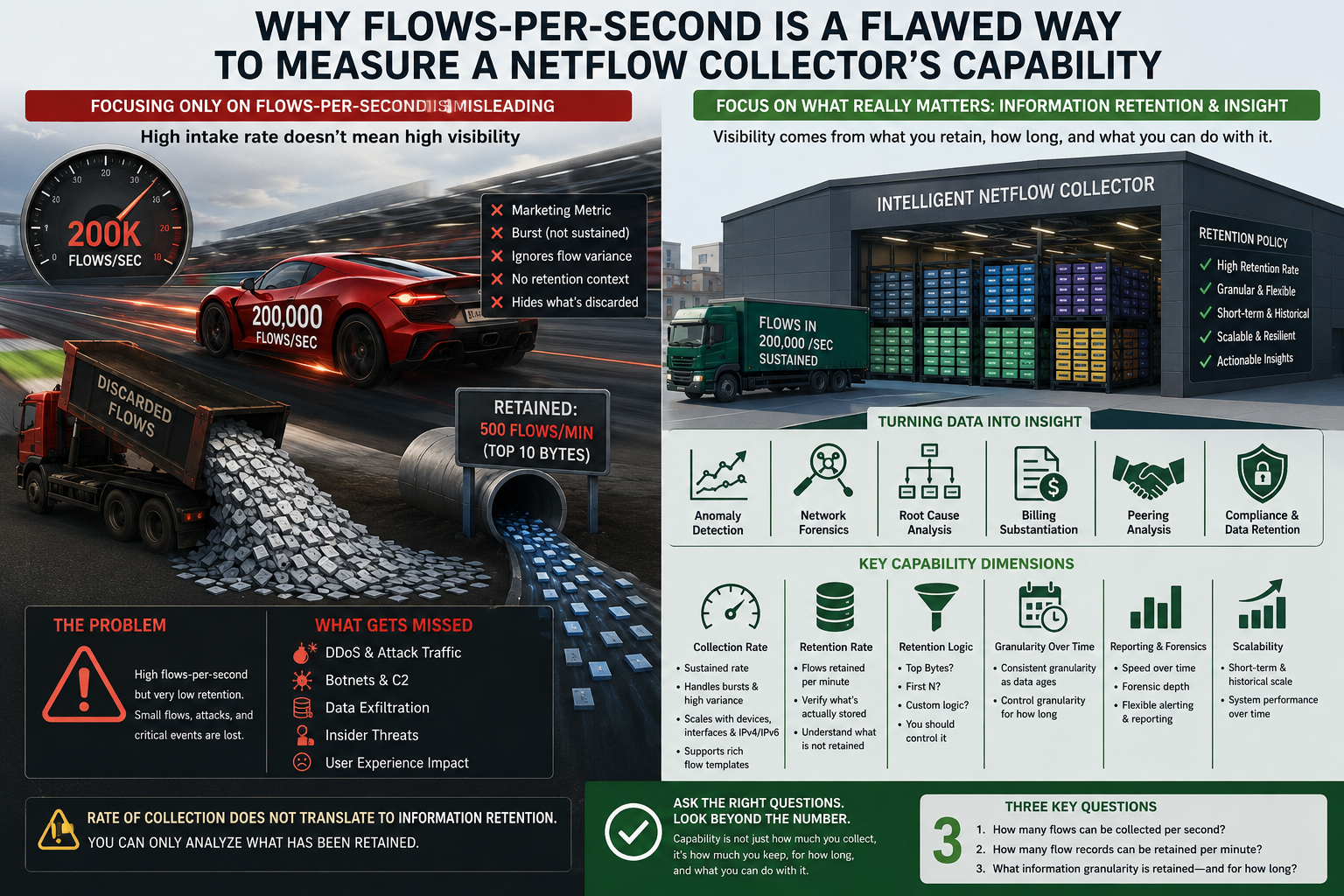
A vendor may claim that its collector accepts hundreds of thousands or millions of flows per second. That figure can be technically correct while still creating a misleading impression of the product's real capability.
Receiving a flow record is only the first stage. A useful NetFlow platform must also process, enrich, retain and analyze the record.
A flows-per-second benchmark generally measures only the first stage. It may reveal little about the performance or limitations of the remaining three.
Collection rate is not information retention
A collector can receive a large volume of flow records while retaining only a small fraction of them. The discarded records may be sampled, aggregated, summarized or permanently removed before they reach long-term storage.
This distinction matters because a platform can only report on, investigate or apply AI to the information that remains available.
Once a flow is discarded, it cannot be searched, reconstructed, correlated or supplied to an AI model during a later investigation.
A simple comparison
Collector A
- Receives 2 million flows per second
- Retains only 500 selected records per minute
- Prioritizes the largest bandwidth consumers
- Discards most low-volume conversations
- Provides limited historical forensic context
- Supplies AI with a reduced version of events
Collector B
- Receives 500,000 flows per second
- Retains every relevant flow record
- Preserves communication context and timing
- Supports detailed short-term and historical analysis
- Maintains searchable forensic evidence
- Supplies AI with broader and more accurate context
Collector A has the stronger marketing number. Collector B may deliver far greater operational, security and AI value.
Why flows-per-second became the wrong yardstick
Technology performance has often been reduced to one simple number. That approach works only while the number continues to represent the overall capability of the system.
Computer performance was once judged mainly by CPU clock speed. Multi-core processors changed that relationship. A processor could run at a lower clock speed while performing more work through parallel processing.
Flows-per-second has become the NetFlow equivalent of CPU clock speed.
It remains useful as one metric, but it does not describe the capability of the entire flow analytics platform.
What a modern flow collector must preserve
NetFlow was developed to provide network visibility without requiring packet capture systems on every network segment.
A basic flow record commonly includes:
- Source IP address
- Destination IP address
- Source port
- Destination port
- Protocol
- Type of Service
- Ingress interface
- Egress interface
Modern exporters may also include:
- Application identifiers
- Application categories
- URLs and hostnames
- MAC addresses
- TCP flags
- Latency measurements
- MPLS information
- Cloud metadata
- Network performance measurements
- Security and identity context
These fields improve analytical value, but they also increase record size and processing requirements. A benchmark based on a minimal flow template may bear little resemblance to performance with a real production template.
Why detailed retention matters to AI
AI systems identify patterns by comparing activity across devices, users, applications, destinations, time periods and prior behavior. Their effectiveness depends on data continuity and context.
When records are selectively removed, the AI may lose:
- The sequence in which activity occurred
- The relationship between small and large flows
- Repeated low-volume communication patterns
- Evidence of gradual behavioral change
- The baseline needed to identify anomalies
- The communications that preceded or followed an incident
- The distinction between unusual and genuinely malicious activity
Better AI does not come only from stronger models. It requires sufficiently complete, granular and historically consistent telemetry.
An advanced model working from incomplete telemetry may still produce a confident answer. Confidence does not make the answer correct.
The risk of Top-N retention
Many traditional NetFlow products were designed primarily for bandwidth reporting. To reduce processing and storage requirements, they may retain only selected records using methods such as:
- Top Bytes
- Top Conversations
- Top Sources or Destinations
- First N records
- Sampling
- Time-based aggregation
- Progressive historical roll-ups
These methods can be useful for identifying major bandwidth consumers. They are much less effective when the activity of interest is distributed across many small flows.
Modern security and operational risks often include:
- DDoS activity
- Botnet communications
- Command and Control traffic
- Malware beaconing
- DNS tunneling
- Credential attacks
- Lateral movement
- Peer-to-peer activity
- Insider activity
- Low-and-slow data exfiltration
- Automated scanning
- MFA bypass-related activity
Individually, these flows may never appear in a Top 10 or Top 100 report. Collectively, they may describe the complete attack chain.
A platform that retains only the largest flows may provide an accurate view of bandwidth consumption while remaining blind to the activity that presents the greatest operational or security risk.
Granularity determines what can be investigated
Retention is not merely a question of whether some data is stored. The level of detail and time granularity must also be considered.
A product might retain:
- Minute-level data for one day
- Hourly summaries after two days
- Six-hour aggregates after one week
- Daily summaries after one month
This may be adequate for long-term trending, but it can be insufficient for reconstructing a security event or explaining why a device, user or application behaved abnormally at a specific time.
AI-assisted historical analysis faces the same limitation. If detailed temporal relationships have been removed, the model cannot accurately reconstruct the original sequence of events.
Real scalability must be measured across the entire system
A NetFlow platform is scalable only if it continues to collect, retain and analyze useful information as the environment becomes more demanding.
A meaningful assessment should include:
- Sustained collection rate
- Burst handling capacity
- Flow retention rate
- Percentage of records retained
- Information granularity
- Retention logic
- Number of devices and interfaces
- IPv4 and IPv6 cardinality
- Flow template complexity
- Enrichment processing requirements
- Alerting responsiveness
- Historical query performance
- Concurrent reporting performance
- Forensic depth
- AI analysis performance
- Storage efficiency
- Performance as the database grows
- Performance under attack conditions
A short benchmark against an empty database does not demonstrate how the platform will behave after months or years of continuous collection.
Three questions to ask your NetFlow vendor
How many flows can be collected per second?
- Is the quoted figure a burst rate or a sustained rate?
- For how long was the rate maintained?
- What hardware, memory and storage architecture were used?
- Was the test performed against an empty or mature database?
- How does performance change during high flow variance?
- What happens during a DDoS attack or sudden traffic burst?
- How does performance change as devices and interfaces are added?
- How do IPv4 and IPv6 cardinality affect performance?
- How do richer flow templates affect the quoted rate?
- Does enabling enrichment, analytics or AI reduce the stated capacity?
How many flow records are actually retained?
- How many individual records are written to storage each minute?
- What percentage of received records is retained?
- Can the retained record count be independently verified?
- Does the same retention rate apply to recent and historical data?
- What happens to records that are not retained?
- Are records aggregated, sampled, summarized or permanently discarded?
- What selection logic determines which records survive?
- What information is available to AI before and after retention reduction?
What information granularity remains available over time?
- Is every individual flow retained?
- Does minute-level data later become hourly or daily data?
- Are detailed records replaced by summaries?
- Can administrators control the retention granularity?
- How long is full-resolution information retained?
- Can historical records still be searched quickly?
- Can the original communication sequence be reconstructed?
- Does the AI analyze original records or only summarized data?
- How does reduced granularity affect anomaly detection and investigation accuracy?
The practical test
Do not ask only how much data enters the system
Ask what remains available when an analyst or AI system must investigate an event that occurred yesterday, last month or six months ago.
Determine whether the platform retained the individual flows, contextual fields, relationships and time granularity required to explain what actually happened.
Then test whether reports, searches, alerts and AI-assisted investigations remain accurate and responsive after the system has accumulated a realistic volume of historical data.
Frequently asked questions
What does flows-per-second measure?
Flows-per-second measures how quickly a collector can receive exported flow records. It does not measure how many records are retained, how much context survives or how quickly historical data can be analyzed.
Why is flow retention important for AI?
AI requires sufficiently complete and consistent telemetry to identify patterns, compare behavior and reconstruct events. Missing or aggregated flow records can distort the context and reduce the accuracy of AI-assisted detection and investigation.
Can a collector advertise high FPS while storing very little?
Yes. A product may accept a high volume of incoming records while storing only selected flows, Top-N results, samples or time-based summaries.
What matters more than a headline FPS figure?
Sustained ingestion, retention percentage, information granularity, historical depth, query speed, forensic capability, AI data quality and performance as the database grows are all important.
Conclusion
Flows-per-second remains a useful indication of ingestion capacity, but it should never be treated as a complete measure of NetFlow collector capability.
The real measure is the platform's ability to preserve useful information, maintain sufficient granularity, support fast analysis and continue performing as traffic, devices, users and historical data increase.
This is particularly important for AI-driven security observability. The accuracy of AI-assisted detection and investigation depends not only on the quality of the model, but also on the completeness and fidelity of the evidence supplied to it.
Rate of collection does not equal information retention. AI can only reason accurately from the evidence that has been preserved.